 -
-  -
-  -
-  -
- 
PCM Energy P. Ltd
PCM Phase Change Material Manufacturers for Air Conditioner Conditioning & Heating HVAC USA
 | |
| Heat Exchanger Stackable & Wall Mountable PCM-Filled Profiles | |
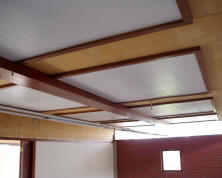 |  |
| Natural Air conditioning with PCM in Ceiling | PCM Cooled AC Office building in Netherlands. |
 Pl click to enlarge
Overview
The fossil fuels that we have been using since a few decades have been formed in the earth’s crust, over millions or billions of years. The rate at which we are using them will not make it available in a few hundred years, even with the improved tapping methods. Our generation is concerned about reducing our carbon foot print. Global warming and heat waves have brought scientists attention, all over the world, to search of new and renewable energy sources.
Cooling & Heating demand (HVAC) has already been increasing due to the evolving comfort expectations and technological development around the world. Significant economic benefit can be achieved by thermal energy storage for heating and cooling in buildings. Energy storage systems provide the potential to not only save energy but also reduce the environment impact related to energy use. In fact, these systems provide a valuable solution for correcting the mismatch that is often found between the supply and demand of energy. Latent heat storage in a (PCM) is very attractive because of its high storage density with small temperature change.
We strongly recommend that Incandescent Lamps or bulbs should not be used. They have a short life and give 10 times less light than a LED or Fluorescent Lamp. They not only increase your energy bill for lighting but also add to your energy bill for Air conditioning.
About Energy Saving WindowsThe object is to cut your home energy consumption for heating and cooling in half. To do this the transfer of heat between the outside and inside of your home must be reduced to a minimum by effectively insulating the home. If the Air Handling Unit AHU system doesn't continuously have to switch on to maintain the desired temperature inside your home, your energy bill will drop dramatically.
Outdated or failing windows are responsible for a large percentage of the wasted energy in homes and other buildings.
In the winter, windows can leak heat resulting in your burning more fuel and pay higher energy bills. In summer, poorly performing windows let cool air escape and fail to reflect outdoor heat.
Modern, energy-efficient windows and doors can save you 15 to 25 percent on your monthly heating and cooling bills, according to the U.S. Department of Energy. Single sheet of clear glass was the rule a decade ago; there are now windows with multiple glass layers. Special coatings on the glass reflect sunlight and ultraviolet rays without dimming the view. Gases injected between panes create extra insulation. Advanced framing materials and innovative design provide further efficiency gains.
The industry standard for energy-efficient glass coatings has become Low-Emissivity (LoE or Low-E) glazing. Coating a glass surface and gaps between each pane with LoE material can block a significant amount of heat transfer, reducing your home’s need for energy-consuming climate control systems.
Low-E coatings are transparent to visible light, and different types of coatings have been designed to allow for high solar gain, moderate solar gain or low solar gain. These coating offers the lowest U factor and lowest solar heat gain. Inert gases (Generally Argon) pumped into the spaces between panes of glass slow the transfer of heat, increasing the insulating power of a window or door.
"A double-paned window with Low-E glass, with a vacuum-sealed argon fill — that's what people ask for," he says. "It's an extra $40 or so per window for me to add these features, and they really do make a difference in a home's utility bills." John says he's found that doing anything more, like using triple-paned glass or denser gases with greater insulation properties, "just adds cost and gives diminishing returns in efficiency."
So what exactly are you getting when you choose a window with the aforementioned options? "Low-E, argon-filled, double-paned windows provide significantly more insulation than a single-pane window," explains Kendra Weinisch, a residential energy efficiency consultant in San Jose, Calif. "These windows protect the inside of the house from the sun's heat and UV rays in the summer, and they prevent heat from escaping during winter. From the standpoint of energy efficiency and value, these types of windows make a lot of sense."
Making your home more energy efficient by properly insulating your attic, reducing air infiltration rates, accurately managing your AC/H system, and installing the high-tech, super insulating windows with, your family and your home can get more - much more.
In the Chemical Engineering section of the Institute of Chemical Technology, Mumbai India (earlier University Institute of Chemical Technology and much before it was called University Department of Chemical Technology, UDCT as many of its alumni will loving refer to), there are many sections of air conditioned rooms having double doors and double-pane windows. The teaching staff will vouch that saving in AC energy is significant. It was from this observation; we picked up the idea of adding this tip to our page.
About Air Change Rate
Air change rate is measured in appropriate units such as cubic meters per hour divided by the volume of air in the room, or by the number of times the home's air changes over with outside air.
With dramatic improvement in the weather tightness of homes, anyone concerned about indoor air quality in their home, check the amount of fresh air entering there home. Recent cost reductions in CO2 meters and better understanding of the mixing of CO2 from the home occupants allow simple methods of calculating fresh air ventilation rates. Fresh ventilation is the most inexpensive way of controlling indoor pollutants in our home.
A fresh, filtered air change in an occupied home every 3 hours will purge the indoor pollutants and renew oxygen. Nothing else is as cost effective or provides better indoor air quality. By using the recently introduced CO2 meters to monitor your home's CO2 levels, you can determine the actual cfm of fresh air in your home.
The cost of conditioning fresh air is much less than people assume. On windy days you get this without mechanical ventilation. Purging indoor pollutants and renewing oxygen is not expensive. Indoor air quality is worth that.
The US national average of air change rates, for existing homes, is between one and two per hour, and is dropping with tighter building practices and more stringent building codes. Standard homes built today usually have air change rates from 0.5 to 1.0. Extremely tight new construction can achieve air change rates of 0.35 or less. Most homes with such low air change rates have some form of mechanical ventilation to bring in fresh outside air and exchange heat between the two air streams. Recently, ASHRAE Standard 62.2 have been adopted (2004). It clarifies the ventilation air requirements for low-rise residences. The Standard specifies that forced ventilation is required in houses with infiltration less than 0.35 ACH. It is important to check that AHU Ducts are sealed.
It will not be out of place here to state that there are many days in a year and many hours in such day, when you can switch off your AC and open the window. Living with open windows is a pleasant experience. The saving in the cost of energy is over and above the big pleasure of living with open windows.
More saving in energy cost of AC can be achieved by setting the Air conditioner to a higher temperature say, 78-80C and using a slow speed fan. This will reduce the AC cost by 30%.
About Insulation of House & Window Types
The R-Value of Insulation
An R-value indicates insulation'sresistance to heat flow. Higher the R-value, greater is the insulating effectiveness.
The R-value depends on the type of insulation and includes its material, thickness, and density. When calculating the R-value of a multilayered installation, add the R-values of the individual layers. Installing more insulation in your home increases the R-value and the resistance to heat flow.
The effectiveness of insulation's resistance to heat flow also depends on how and where the insulation is installed. For example, insulation that is compressed will not provide its full rated R-value. The overall R-value of a wall or ceiling will be somewhat different from the R-value of the insulation itself because some heat flows around the insulation through the studs and joists. Therefore, it's important to properly install your insulation to achieve the maximum R-value. The amount of insulation or R-value you'll need depends on your climate, type of heating and cooling system, and the section of the house you plan to insulate.
Selecting Insulation
Selecting Insulation for New Home Construction
Your state and local building codes probably include minimum insulation requirements, but to build an energy-efficient home, you may need or want to exceed them. For maximum energy efficiency, you should also consider the interaction between the insulation and other building components. This is called thewhole-house systems design approach.
To properly insulate a new home, you first need to knowwhere you need to insulate and the recommended values of R-values for each of those areas. Use the U.S. Department of Energy's Zip Code Insulation Calculator to determine where you need to insulate and the recommended R-values based on your climate and type of heating and cooling system, etc. The program also will provide cost estimates and a rate of return.
Before you insulate a new home, you also need to properlyair seal it and consider the best method ofmoisture control.
Dulleys Webpage
For new construction or home additions, R-19 insulation for exterior walls is recommended for most of the country. To meet this recommendation, most homes and additions constructed with 2 x 4 walls require a combination of wall cavity insulation, such as batts, and insulating sheathing, such as rigid foam boards. You may want to consider building with 2 x 6 framing instead of 2 x 4 framing to allow room for thicker wall cavity insulation — R-19 to R-21.
Look for more on R-values on line.
Energy Star Insulation
Comprehensive air sealing, properly installed insulation, and high–performance windows work together to enhance comfort, improve durability, reduce maintenance costs, and lower monthly utility bills. Learn more about a complete thermal enclosure system in this fact sheet
Air Sealing
By using less energy for heating, cooling, and water heating, ENERGY STAR certified homes deliver approximately 20% savings on annual utility bills. Over the 7 to 8 years that a typical family lives in a home, you can save thousands of dollars in maintenance cost.
Properly Installed Insulation
It’s not the amount of insulation; it’s the quality of installation that makes all the difference. Proper installation includes careful placement to eliminate gaps, voids, and compression; complete air barriers that prevent air from bypassing the insulation; and building techniques that minimize heat flow through framing. This ensures consistent temperatures throughout the house, reduced energy use, and increased comfort.
High–Performance Windows
Advanced technologies, like protective coatings and improved frames, help keep heat in during winter and out during summer. They also block damaging ultraviolet sunlight that can discolor carpets and furnishings.
AC Size Calculation
Calculator is based on the square foot method, with computations added for the most important values included, such as insulation, windows and other factors. The system is pre-set to a 72F degree indoor temp and 95F outdoor temperature.
This calculator is provided for use as a super quick method of computing basic size and value conditions.
Square foot methods are considered rule of thumb for quick calculations. Exact heat loads can be determined with a full heat load analysis.
AC Size Calculation (Thumb Rule)
Phase Change Material Introduction
Ice changes phase when heated at 0 deg C and is converted to water. Ice is an excellent PCM.
It absorbs a large amount of heat in the process of changing from solid to liquid phase resulting in cooling of the surroundings. But what if you require this heat at a temperature other than zero? This 'heat-on-demand' requirement is satisfied by PCM which works at specified temperatures. Inspite of the research on the subject, scientists did not manage to develop a suitable PCM which works at a temperature closer to human comfort. At PCM Energy, we have perfected the art and the commercial viability has been demonstrated by various users in Netherlands. For use of PCM-AC in Europe, we recommend Autarkis of Netherlands.
PCM scan be broadly classed as Organic and Inorganic.
Organic PCM:
Users rarely specify the use of Organic PCM. Latest TM can offer Organic PCM in low temperature range. Organic items are expensive and they have average Latent Heat per unit volume and low density. Most items in organic range are combustible in nature.
Inorganic PCM:
Inorganic Thermal Salt is generally Hydrated Salt based material. Academicians are likely to misguide you into using pure hydrated salts like Sodium Sulphate Decahydrate and so on. Hydrated salts have a number of hydrates and an anhydrous form leading to stratification of material and loss of Latent Heat recovery with time. Hydrated salts also have a sub-cooling tendency. Old generation Thermal Salt manufacturers managed to add performance-enhancing agents. These additives do help in delaying the degradation of the thermal salt for say 100 cycles or thereabout. However, they do not address the basic reasons due to which sub-cooling and degradation happens. Earlier researchers emphasized that it is beneficial to use impure grades of base material as it promotes the nucleation and prevents sub-cooling. However, impurities also promoted nucleation of undesirable hydrates leading to stratification. Experts on crystallography have managed to identify the “Preferred Crystal Nucleation” method. It consists of a “Cold Finger” that nucleates and promotes the growth of desired crystals and “Detoxification” or “Selective Elimination” whereby any impurity that promotes the growth of undesirable crystals is removed. The current methods of Thermal Salt manufacturing are like the new generation “Combination Drugs”. Our team of scientists and engineers has arrived at a customized PCM solution for air conditioning need.
Inorganic PCM is always recommended as they are non inflammable.
Phase change material (PCM) can reduce heating, ventilation, and air conditioning (HVAC) costs by a number of different mechanisms, including: eliminating air conditioning costs by storing nighttime coolness for use during the day, eliminating heating costs by storing daytime warmness for use during the night, and by load-shifting of electricity through thermal storage. Well-designed strategies and utilization of PCM could easily reduce HVAC-related carbon dioxide emissions by more than 50% from current levels.
• PCM in building walls & Ceiling.
The first method, where the heat or cold stored is automatically released when indoor or outdoor temperatures change beyond the melting point. Thermal energy storage in the walls, ceiling and floor of buildings may be enhanced by encapsulating PCM within these surfaces. They can either capture solar energy directly or thermal energy through natural convection. Increasing the thermal storage capacity of a building can increase human comfort by decreasing the frequency of internal air temperature change so that the indoor air temperature remains at desired temperature for a long period of time.
• PCM in separate heat exchanger cum storage
The second method is active systems, where the stored heat or cold is in containment thermally separated from the building by insulation. Therefore, the heat or cold is used only on demand and not automatically.
Peak load shifting is the easiest application of PCM. In the summer time, air conditioners and most industrial equipment tends to naturally operate during the middle of the day when the sun’s heat is the greatest and people are at work running equipment. Peak demand for electricity would be many times greater than the baseline load. This variation leads to a differential pricing system for peak and off peak periods of energy use. Economic benefit can be achieved if some of the peak load could be shifted to the off peak load period that can be achieved by thermal energy storage for heating and cooling buildings.
Peak Load Shifting for Offices used in Day Time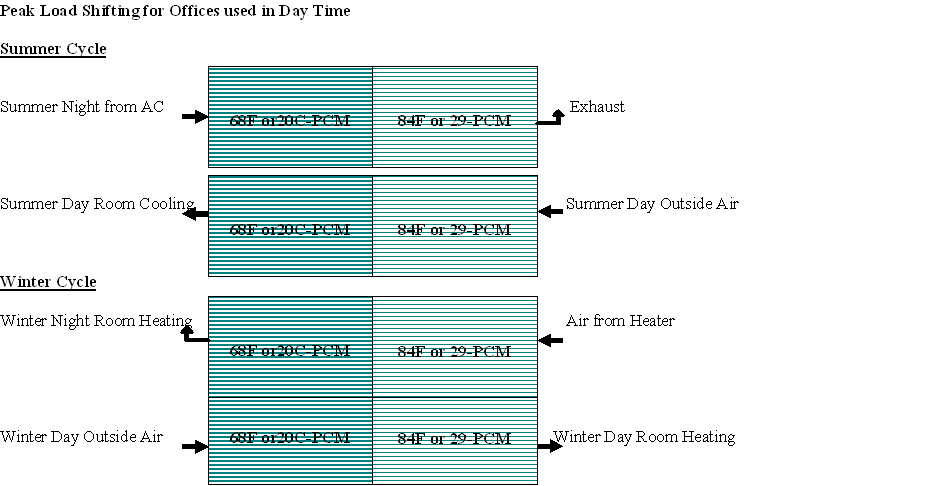 Pl click to enlarge
The figure describes the night time charging and day time utilization process during both heating and cooling seasons for a storage system comprising of two different PCM integrated into a reverse cycle refrigerative heat pump system utilizing off peak power. Using a thermal storage system containing two different PCM can reduce the required capacity and the initial cost of air conditioner for a building. It also can shift a portion of the energy load (heating and cooling) to off peak hours, when electricity cost is lower.
With user cooperation, peak demand can be reduced to being 50%. This not only benefits the consumer, who pays non-peak tariff but also the energy provider and the state and the world as a whole.
This method has been described by:
Dr Frank Bruno Ph.D., B.Eng.(Hons.) of Sustainable Energy Centre, University of South Australia.
A. Pasupathy and R. Velraj, Department of Mechanical Engineering, College of Engineering ,Anna University, Chennai – 600 025
An excellent method that practically switches off Air condition cooling AC and heater for almost 6 months a year is described by A J Kamdar. Until today only one small company which is in India is offering the Phase Change Material (PCM) that can be used in AC and heater at Human comfort temperature. Human comfort can be classed as between 19C (66F) and 29C (84F). Depending upon the region in which the people stay, they will adjust to relative cool or hot indoors. 19C (66F) will be fine for people in Northern tip of America but too cool for the people living near tropics. Similarly, 29C (84F) will be ok for tropical people but not for people in Chicago. Fortunately PCM can accommodate this change.
Houston Average Temperature:
Month ----- High -- Low --- ΔT -- Mid-way ---------- Comments
January --- 62°F -- 41°F -- 21 -- Can not balance -- Use heater during non-peak electric tariff hours
February -- 67°F -- 44°F -- 23 -- Can not balance -- Use heater during non-peak electric tariff hours
March ----- 73°F -- 51°F -- 22 -- Can not balance -- Use heater during non-peak electric tariff hours
April ----- 79°F -- 57°F -- 22 -- Balance @ 68°F --- Heats with PCM 76
May ------- 86°F -- 66°F -- 20 -- Balance @ 76°F --- Cools & Heats with PCM 76 (or 80+76)
June ----- 91°F -- 72°F -- 19 -- Balance @ 81°F --- Cools with PCM 76 (or 80+76)
July ------ 94°F -- 74°F -- 20 -- Balance @ 84°F --- Cools with PCM 76 (or 80+76)
August ---- 94°F -- 73°F -- 21 -- Balance @ 84°F --- Cools with PCM 76 (or 80+76)
September - 89°F -- 68°F -- 21 -- Balance @ 78°F --- Cools with PCM 76 (or 80+76)
October --- 82°F -- 59°F -- 23 -- Balance @ 70°F --- Cools & Heats with PCM 76 (or 80+76)
November -- 72°F -- 50°F -- 22 -- Can not balance -- Use heater during non-peak electric tariff hours
December -- 65°F -- 43°F -- 22 -- Can not balance -- Use heater during non-peak electric tariff hours
For PCM HVAC & Heating & Cooling in Dallas, Austin, Atlanta Georgia, Maryland Richmond Virginia, Chicago Illinois, Las Vegas & other cities please click
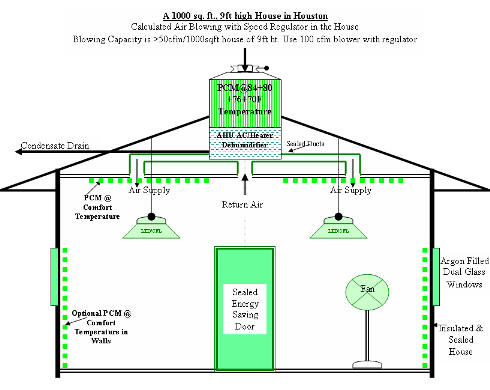
 Pl click to enlarge
A house of 1000sq.ft and 9ft height has a volume of 9000 cu. ft.
Sp. Heat of air is 1KJ/Kg/K; And density is 1.2Kg/M3
For 25F (25*5/9 =13.89K) change of temperature 1M3 of air will need 1.2*25*5/9KJ = 16.67KJ
1M3=35.29cu.ft. Hence 35.29cu.ft. needs 16.67KJ
9000cuft (i.e the full volume of the house) needs 16.67*9000/35.29=4252KJ or 4252KJ/hr=4252/3600=1.18KWH
After adjusting for other losses it can go up to 2KWH
The ordinary forced air change rate is 0.35/hr and hence the wattage will be 2KWH/3hr
This 100F heat remains for maximum 3 hour. Average load for overlapping 12 hours will be half this value. This makes total load as 2+4=6 KWH. The rest of the time is cooling & charging period for PCM.
The blower capacity for PCM utilization is 52.5cfm=52.5*60 i.e.3150cuft/hr. We must buy a blower of 100cfm (Higher cfm is proposed as the blower may not give the rated output) and provide a regulator.
This means we must install 6KWH of PCM-80+75. Which is equal to 120kg or 265 lbs of PCM 50% of it melting at 80F and 50% melting at 75F. We may also install (optional) about 100lbs of PCM in walls.
Any company already in the business of HVAC or in developing new buildings in a big way can benefit tremendously by using this method. You can expect government support and carbon credits over and above the routine business benefits.
For a PCM cooled low humidity 7200 sq. ft. ware house click Air conditioned by PCM - Phase Change Material in Houston, USA.
PCM - Air Conditioning with Phase Change Material Manufacturers
PCM Energy P. Ltd
Mumbai 400 010, INDIA
TEL: 91-22-65290112
Current Date Time in India is GMT+5:30
Email: anmol@pcmenergy.com
Copyright and Usual Disclaimer is Applicable
Last updated: 19.04.2026


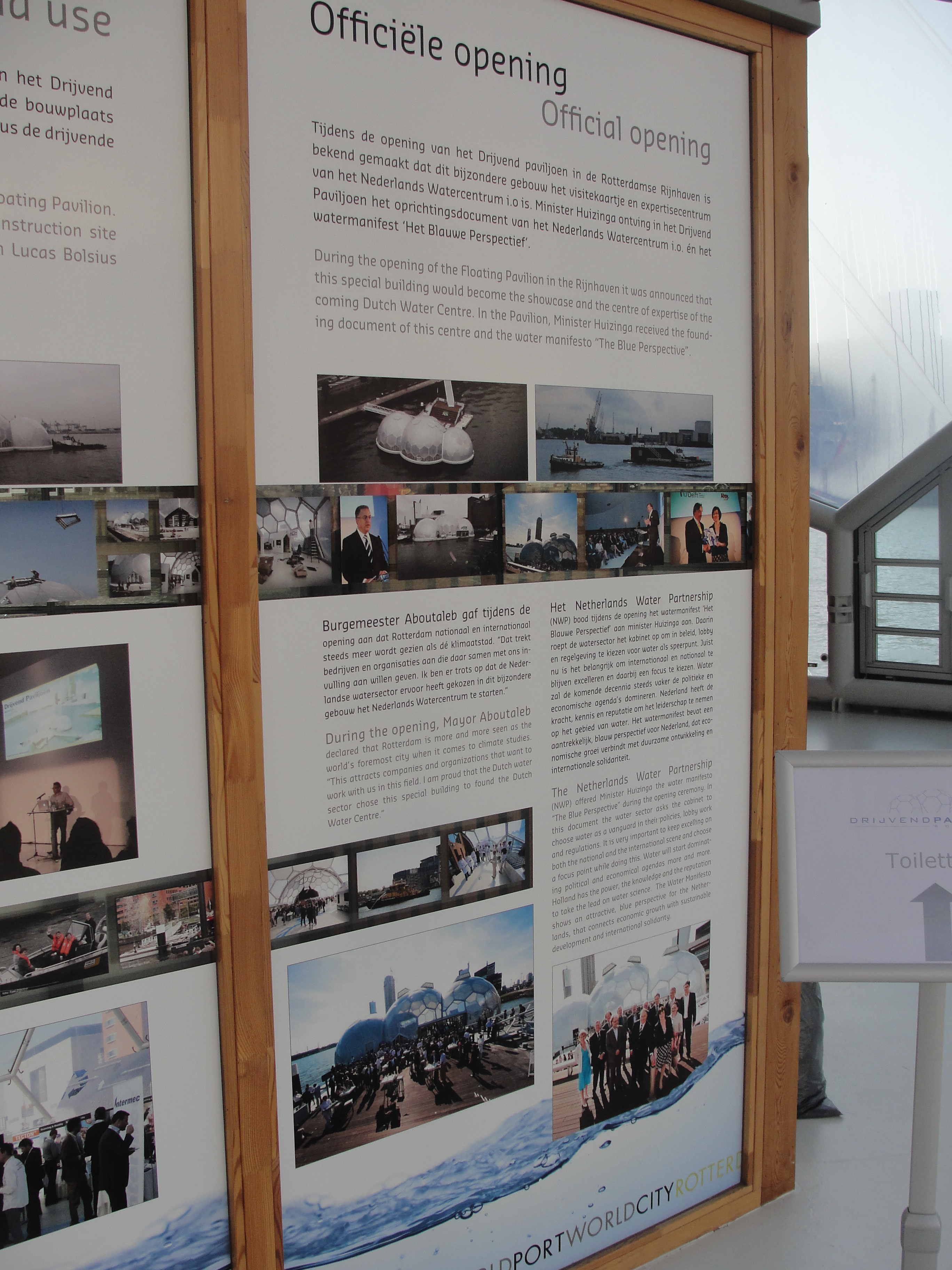
Floating Balls of Rotterdam cooled (Air Conditioned) by PCM.
PCM Phase Change Material Suppliers & Exporters to USA (Representatives in Houston Texas & Chicago Illinois) Canada UAE Dubai & Europe South Africa Egypt Turkey Mexico Brazil Argentina Chile European areas like England UK Switzerland France Poland Italy Netherlands Sweden Spain Australia Korea etc.